Biblical solar timekeeping for beginners can sound more settled than the ancient evidence really is.
The Bible and related ancient Hebrew and Second Temple-period writings contain many ways of speaking about days, months, seasons, festivals and years. Among those writings is an important 364-day tradition associated with the Book of Enoch and with calendrical texts found among the Dead Sea Scrolls.
This article introduces that tradition without treating it as the single calendar used by every ancient Israelite or Second Temple-period community.
It also keeps four things separate: what an ancient text says, what surviving manuscripts show, how scholars interpret that evidence, and how a modern system such as the Master Enoch Clock works with it today.
What does “biblical solar timekeeping” mean?
There is no single ancient work called Biblical Solar Timekeeping.
The phrase is useful as a modern description for studying ancient ways of organising time in which the sun, the changing length of daylight, the seasons and the structure of the year are especially important.
The Hebrew Bible contains references to days, months, Sabbaths, new moons, agricultural seasons and appointed times. It does not present every calendar question in one technical system.
A more detailed astronomical and calendrical scheme appears in 1 Enoch, especially the section usually called the Book of Luminaries or Astronomical Book.
That is why most discussions of an Enochic solar calendar begin there rather than assuming that one calendar system can simply be read across every biblical text.
What is the Book of Luminaries?
The Book of Luminaries is the name commonly given to 1 Enoch chapters 72–82.
It describes the ordered movements of the heavenly lights, including the sun and moon, changes in the lengths of day and night, and the ordering of the year.
The text uses an ancient picture of heavenly “gates” through which the sun and moon pass. These gates belong to the cosmological language of the work and should not be confused with modern astronomical coordinates.
The Book of Luminaries is also connected with older Aramaic astronomical material preserved among the Dead Sea Scrolls. The surviving Aramaic manuscripts are commonly identified as 4Q208–4Q211.
Those fragments are especially important because they show that the Enochic astronomical tradition existed in Aramaic centuries before the surviving complete Ethiopic form of 1 Enoch.
How does the 364-day year work?
The Enochic tradition presents an ordered year of 364 days.
A common way of expressing its structure is four quarters of 91 days each:
91 + 91 + 91 + 91 = 364 days
Within the year, the month pattern can be expressed as:
30 days · 30 days · 31 days
That pattern repeats four times.
The four quarter-ending days therefore belong inside the 364-day count. They are not four days added after a separate 360-day year.
Because 364 divides exactly by seven, the structure contains:
52 complete weeks
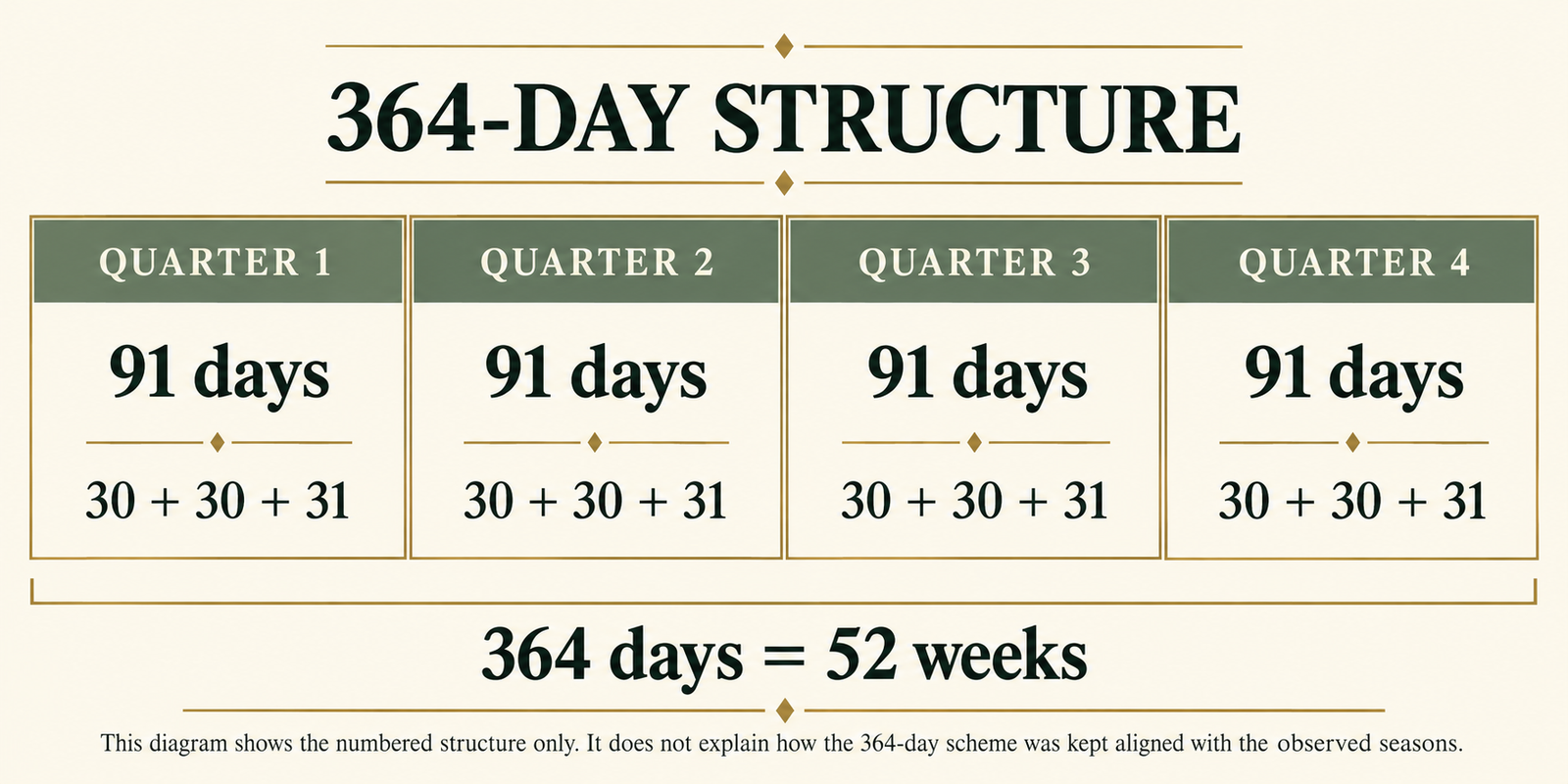
This is one reason the scheme is important in discussions of ancient Israelite and Second Temple-period calendars: the numbered year and the seven-day week fit together without a leftover numbered day.
Does a 364-day year automatically stay with the seasons?
No.
This is one of the most important things for a beginner to understand.
A mathematical calendar of 364 numbered days is shorter than the observed seasonal or tropical year. A calendar cannot remain aligned with the seasons indefinitely simply because its internal structure is neat.
The ancient texts therefore leave modern readers and scholars with a real question: how was the relationship between the 364-day scheme and the observed return of the seasons understood or managed?
Different ancient texts, reconstructions and modern interpretations approach that problem in different ways. The evidence should not be made more certain than it is.
The existence of a 364-day scheme and the question of how that scheme remained related to the seasons are two different questions.
Why do the fifty-two weeks matter?
A 364-day year contains exactly fifty-two seven-day weeks.
That creates a regular weekly pattern inside the numbered year.
In calendrical texts connected with the Dead Sea Scrolls, this kind of regular structure can be coordinated with festivals, priestly courses and other cycles.
But the mathematical regularity should not be turned into the stronger claim that all ancient Israelite and Second Temple-period communities used the same schedule or that historical practice never changed.
Ancient Israelite and Second Temple-period calendrical evidence is diverse.
Was the Enochic calendar purely solar?
Calling the 364-day scheme a “solar calendar” is convenient, but it can hide some complexity.
The Book of Luminaries gives major attention to the sun and to the changing lengths of day and night. At the same time, the work also contains substantial lunar material.
Aramaic astronomical manuscripts from Qumran preserve calculations involving both sun and moon.
For that reason, scholars may describe these traditions using terms such as solar, schematic, sabbatical or synchronistic depending on which part of the evidence they are discussing.
A beginner therefore does not need to choose between “the sun mattered” and “the moon appears in the evidence”. Both are true.
What do the Dead Sea Scrolls add?
The Dead Sea Scrolls contain an important body of calendrical and astronomical material.
Some manuscripts use 364-day frameworks. Some coordinate dates with priestly courses, festivals or other repeating cycles. Aramaic manuscripts also preserve material related to the Enochic Astronomical Book.
This shows that 364-day calendrical thinking was part of Second Temple-period literature and was not created by modern readers of the Ethiopic Book of Enoch.
It does not prove that every person represented by the Dead Sea Scrolls followed one identical calendar in daily life.
It is also too simple to say that one clearly identified “Qumran community” wrote every scroll, or that archaeology by itself proves exactly how each calendrical text was practised.
The relationship between the manuscripts, the archaeological site and particular Second Temple-period groups remains a subject of scholarship.
Were there other Israelite and Second Temple-period calendars?
Yes.
Ancient Israelite and Second Temple-period calendar evidence was not uniform.
Sources from the Second Temple period preserve different calendrical ideas, including solar, lunar and lunisolar approaches.
Later rabbinic calendrical practice also developed over time.
That means it is safer to speak about an Enochic 364-day tradition than to call it simply “the ancient biblical calendar” as though no competing evidence existed.
Solar and lunisolar calendars are not opposites in the simplest sense
A solar calendar organises the year primarily in relation to the sun or seasonal year.
A lunar calendar follows cycles of the moon.
A lunisolar calendar uses lunar months while making adjustments so that those months remain related to the solar seasons.
That last point matters because a properly adjusted lunisolar calendar does not simply drift endlessly away from the seasons. Intercalation is used precisely to correct the difference between lunar months and the solar year.
Likewise, calling a 364-day calendar “solar” does not mean that 364 numbered days equal the observed solar year exactly.
Both systems raise questions about how an ideal or numbered calendar relates to astronomical observation.
How should a beginner start?
1. Read the source before trying to reconstruct the calendar
Begin with 1 Enoch 72–82 in a reputable translation.
Do not worry if every description is not immediately clear. The material is difficult, and some of the ancient cosmological language does not map neatly onto modern ways of describing astronomy.
As you read, note separately what the text says about:
- the sun;
- the moon;
- day and night;
- the twelve months;
- the four quarters;
- the total of 364 days.
2. Keep the source and the reconstruction separate
A modern diagram can be useful, but it is already an interpretation of the ancient material.
When someone says, “This is how the Enoch calendar worked”, ask a second question:
Which ancient text establishes that particular step?
If the answer comes instead from a modern reconstruction, that does not automatically make it wrong. It simply needs the correct label.
3. Learn the basic arithmetic
You do not need advanced mathematics to understand the numbered structure.
- 7 days × 52 weeks = 364 days
- 91 days × 4 quarters = 364 days
- 30 + 30 + 31 days = 91 days
Those relationships explain the internal order of the scheme.
They do not, by themselves, solve the separate question of how the scheme relates to the observed seasonal year.
4. Learn about the manuscript evidence
The Dead Sea Scrolls matter because they give access to Aramaic Enochic astronomical material and other ancient calendrical texts.
Learning which manuscripts preserve which kinds of material makes it easier to avoid treating every Qumran calendar text as though it were the same document.
5. Compare scholarly interpretations
Calendar reconstruction is an area where small assumptions can produce very different conclusions.
Compare more than one serious scholarly treatment, especially when a modern writer claims that an ancient calendar problem has been completely solved.
What can you observe for yourself?
You can observe that daylight changes through the year.
You can record sunrise and sunset times for your location, notice how the length of daylight changes, and learn what the equinoxes and solstices mean in modern astronomy.
Those observations can help you understand why ancient writers were interested in seasonal light.
But your local observations should not automatically be treated as the exact observations assumed by an ancient text.
Latitude, horizon, atmosphere and the definition being used for sunrise or sunset all matter.
Where does the Master Enoch Clock fit?
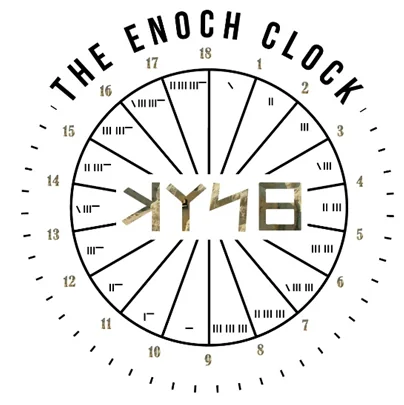
The Master Enoch Clock is a modern system created to make the Enochic 364-day tradition explorable for a date and time.
It is not an ancient manuscript and is not presented as a recovered historical clock.
Its public framework keeps the ancient 364 numbered days intact while using a modern tested geometric solar reference for its calculations.
The modern system also has to deal openly with the fact that the observed return of the seasons takes longer than 364 days.
When needed, the Master Enoch Clock uses what it calls the Solar Renewal Wait: one or two unnumbered sunset-to-sunset days may occur after Day 363 before the spring solar balance, when the night is equal to the day, begins Day 364. The following sunset begins Day 1.
This is a modern operational interpretation used by the Master Enoch Clock.
It is not presented as an extra command written in the Book of Enoch.
That distinction is important: the ancient source, scholarly reconstruction and modern working system are related, but they are not the same thing.
Common mistakes to avoid
“364 days automatically equals the solar year”
It does not. The numbered scheme is shorter than the observed seasonal year.
“Everyone in ancient Israel used this calendar”
The surviving evidence does not support that claim. Ancient Israelite and Second Temple-period calendrical practice was diverse.
“The Dead Sea Scrolls prove exactly how the calendar was used”
The scrolls provide important textual evidence, but interpretation is still required. Manuscripts, archaeological context and historical practice are not interchangeable.
“The moon does not matter in Enochic astronomy”
The Enochic astronomical tradition contains substantial lunar material as well as its strong solar and seasonal interests.
“A modern reconstruction is the ancient text”
Every modern working calendar has to make interpretive decisions. Those decisions should be stated rather than silently attributed to Enoch.
A useful way to keep the evidence organised
As you study biblical solar timekeeping, keep five layers separate:
- Scriptural and ancient text: what the source actually says.
- Manuscript evidence: what survives physically from antiquity.
- Historical practice: what can reasonably be said about how ancient communities used calendars.
- Scholarship: how researchers reconstruct and debate incomplete evidence.
- Modern application: how a present-day project chooses to make the material usable.
Confusion usually begins when two or more of these layers are treated as though they were identical.
Frequently asked questions
What is biblical solar timekeeping?
It is a modern umbrella phrase for studying biblical and related ancient Hebrew and Second Temple-period approaches to time in which the sun, seasons and solar ordering are important. It should not be taken to mean that every biblical text or ancient Israelite or Second Temple-period community used one identical solar calendar.
Does the Book of Enoch contain a 364-day year?
Yes. The Book of Luminaries in 1 Enoch presents a 364-day order associated with the movements of the heavenly lights and the changing lengths of day and night.
How is the 364-day year arranged?
It can be expressed as four 91-day quarters. A repeating 30-day, 30-day, 31-day month pattern gives twelve months and a total of 364 numbered days, or fifty-two complete weeks.
Does 364 days stay aligned with the seasons automatically?
No. The observed seasonal year is longer than 364 days. How ancient 364-day schemes related to that difference is an important interpretive and historical question.
Did the people associated with the Dead Sea Scrolls use a 364-day calendar?
Many calendrical texts among the Dead Sea Scrolls use 364-day frameworks, and some coordinate them with priestly courses and festivals. That evidence is significant, but it should not be expanded into the claim that every scroll or every Second Temple-period group represented there followed one completely identical practice.
Is the Master Enoch Clock the ancient calendar itself?
No. The Master Enoch Clock is a modern system for exploring the Enochic 364-day tradition. It distinguishes its modern calculation method and Solar Renewal Wait from the ancient source text.
Where should I begin reading?
Begin with 1 Enoch 72–82 in a reputable translation, then compare scholarly work on the Aramaic Astronomical Book, Dead Sea Scroll calendrical texts and the wider history of ancient Israelite, Second Temple-period and rabbinic calendars.