Your moment
The complete date, exact time and timezone you entered.

Ancient Time · Interactive companion
The Book of Enoch describes a 364-day order for the year, linked to the movement of the sun and the changing length of day and night.
The Master Enoch Clock helps you explore that ancient calendar idea for a date and time you choose.
It takes its name and inspiration from the Book of Enoch, also called 1 Enoch.
The part we use most is chapters 72–82. This section is usually called the Book of Luminaries because it describes the ordered paths of the sun and moon, the seasons and the structure of the year.
Related Aramaic astronomical writings were also found among the Dead Sea Scrolls at Qumran. That gives this part of the Enochic tradition an important manuscript history.
Enter a complete date, exact time and timezone. The Master Enoch Clock then works out where that moment sits within its calendar system and returns the reading through ChatGPT.
Tested solar reference · Supported dates 2020–2040
Already subscribed? Open The Master Enoch Clock.
How it works
You reach the Master Enoch Clock through ChatGPT, but ChatGPT does not make up the calendar result itself.
For dates the system supports, a private calculation engine works out the authorised reading first. ChatGPT then explains that result in conversation.
This matters because a language model can misunderstand or invent things. The actual supported reading comes from the private calculation system, not from ChatGPT guessing the answer.
To ask for a reading, you provide four things:
Enter the email address used for your subscription to the Master Enoch Clock.
This is the email connected to your access.
Give the full date you want to explore.
Give the exact time for that reading.
Tell the clock where that civil time belongs by giving the timezone or UTC offset.
What comes back
The private engine behind the Master Enoch Clock works out the authorised result for the date, time and timezone you supplied.
ChatGPT then presents that result in a form you can read and ask questions about.
A reading can include the numbered day, the solar Part for that moment and the relevant solar information used by the Master Enoch Clock.
The result comes from the private calculation system. ChatGPT explains it; it does not invent the underlying reading.
The complete date, exact time and timezone you entered.
The numbered day and position returned for that moment within the Master Enoch Clock system.
The Part from 1 to 18 in which that moment falls.
Relevant sunset, sunrise, daylight and night information where it forms part of the authorised reading.
The Master Enoch Clock returns the reading; ChatGPT helps you understand its parts and how they fit together.
The 364-day order
The Book of Luminaries describes a year of 364 numbered days.
It is arranged as twelve months. The month lengths repeat in this pattern:
30 days · 30 days · 31 days
That pattern happens four times.
The quarter-ending days — Days 91, 182, 273 and 364 — are already part of those 364 days. They are not extra days added on top.
But the observed return of the seasons takes a little longer than 364 days.
The Master Enoch Clock does not solve that difference by quietly renumbering the year or adding Day 365 or Day 366.
Instead, after Day 363, the system may wait through one or two unnumbered days before the spring solar balance is reached, when the night is equal to the day.
We call this the Solar Renewal Wait.
The sunset that begins the spring solar balance, when the night is equal to the day, begins Day 364. The following sunset begins Day 1 of the next numbered year.
So the order is:
The Solar Renewal Wait sits outside the twelve months, the 364 numbered days and the 52 numbered weeks.
It is not called an extra command from Enoch. It is not Day 364, Day 365 or Day 366. It is the Master Enoch Clock’s transparent way of keeping the 364 numbered-day order intact while also waiting for the observed spring solar return, when the night is equal to the day.
This remains part of an ongoing enquiry into how the ancient text and observed solar year relate to one another.
Sunset to sunset
The Master Enoch Clock counts each day from sunset to sunset.
We do this because the Enochic calendar tradition treats sunset as the boundary that begins the next day. So when the sun reaches the system’s sunset point, a new clock day begins.
That sunset starts Part 1.
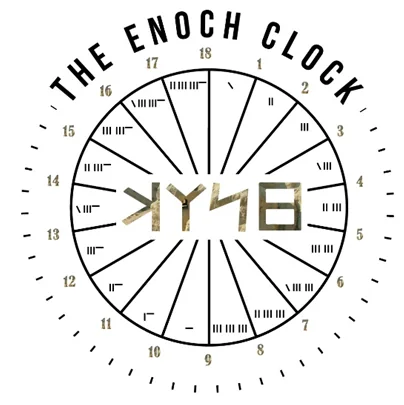
The Book of Luminaries describes changing lengths of day and night using a system of eighteen Parts.
The Master Enoch Clock keeps that eighteen-part structure, but makes it usable for an actual moment in time.
The full interval from one authoritative sunset to the next is divided into exactly 18 equal Parts.
That means every moment between those two sunsets can be placed somewhere from Part 1 to Part 18.
There is no Part 19, no overlap and no missing space between Parts.
On an average 24-hour day, one Part is equal to about 80 minutes.
But the actual time from sunset to sunset changes slightly through the year. Because of that, the displayed minute within a Part is adjusted to the real solar interval for that day rather than treated as a fixed civil 80-minute block.
Part 1 of 18
Book of Enoch · Chapters 72–82
The Book of Enoch, also called 1 Enoch, is an ancient collection of writings linked to the figure of Enoch.
Chapters 72–82 are usually called the Book of Luminaries.
“Luminaries” means the lights in the heavens — especially the sun and moon.
This part of 1 Enoch focuses on their ordered movements, the changing lengths of day and night, the seasons and the structure of the year.
You may also see this section called the Astronomical Book or the Book of the Heavenly Luminaries.
These names point to the same general Enochic astronomical tradition. The Master Enoch Clock is not combining several unrelated books.
The Master Enoch Clock draws on this ancient calendar and astronomical tradition, then uses a modern private calculation method to make the system explorable for a date and time.
The ancient text and the modern calculation method are not the same thing. The website keeps that difference clear.
Manuscript history
Aramaic fragments of Enochic astronomical writings were found among the Dead Sea Scrolls at Qumran.
Several manuscripts, usually called 4Q208–4Q211, are linked with what scholars call the Aramaic Astronomical Book of Enoch.
This is important because it shows that Enochic astronomical teaching existed in ancient manuscript form at Qumran.
But this needs to be understood carefully.
It does not mean that a complete modern Book of Enoch was found there.
It also does not mean that every surviving Aramaic fragment matches chapters 72–82 word for word. The Qumran material belongs to the same wider tradition and preserves material that is not represented in exactly the same way in the later Ethiopic text.
So Qumran is part of the manuscript history of these writings.
We do not present Qumran as Enoch’s location, the place where Enoch received revelation, or proof of the private solar reference used by the Master Enoch Clock.
How the solar reference works
If the Master Enoch Clock used each visitor’s local visible sunrise and sunset, the result would change with mountains, buildings, weather and the atmosphere.
That would make it difficult to compare every reading against one stable version of the 18-part solar system.
So the Master Enoch Clock uses one fixed geometric solar reference for its calculations.
“Geometric” means the calculation uses the centre of the Sun crossing an ideal, clear horizon. It does not try to copy what a person happens to see from a particular garden, hill, city or valley.
The private calculation system uses a precomputed solar standard based on NASA/JPL Horizons DE441 data.
That data helps the system work with the Sun’s position consistently across supported dates.
The exact private reference location, calculations and engine remain protected. They are not needed in order to understand how to use the clock.
The system was tested to see whether its longest and shortest geometric daylight periods reproduce the Book of Luminaries’ 12:6 and 6:12 proportions.
In simple terms, those are the text’s longest-day and shortest-day relationships within an 18-part system.
Across the tested range, the model reproduces those proportions to within ten seconds.
For a supported timestamp, the private engine returns the same result when the same frozen system definition and data are used.
The Master Enoch Clock does not model:
So a sunrise or sunset you physically see from where you are may happen at a different civil time from the geometric sunrise or sunset used by the clock.
The calculation does not prove that:
It is also important to separate the calculation from the conversation around it.
The authorised calculation may be fixed for a supported timestamp, while ChatGPT can still misunderstand a question or explain the result badly.
If something looks wrong, check it and contact us.
These sources support the astronomical terms and manuscript history explained above. They do not endorse the Master Enoch Clock, our interpretation or this commercial product.
Reviewed 28 August 2026.
Access
Try the Master Enoch Clock for one day with £0 due today.
After the free day, the subscription is £9.99 per month. Tax is calculated after you enter your address at checkout.
Your subscription continues until you cancel.
Questions
The Master Enoch Clock is a digital companion that helps you explore the 364-day solar calendar described in the Book of Luminaries, the astronomical section of the Book of Enoch.
You enter a date, exact time and timezone. For supported dates, the system returns where that moment sits within the Master Enoch Clock calendar.
Yes.
The Book of Luminaries is the name commonly given to chapters 72–82 of 1 Enoch, the Book of Enoch.
It focuses on the movement of the sun and moon, the changing lengths of day and night, the seasons and the structure of the year.
It is also called the Astronomical Book or the Book of the Heavenly Luminaries.
Related Aramaic astronomical manuscripts were found among the Dead Sea Scrolls at Qumran. They belong to the same wider Enochic astronomical tradition, although they do not match the shorter form in 1 Enoch chapters 72–82 in every detail.
Because the Enochic calendar tradition uses sunset as the boundary that begins the next day.
That is why the Master Enoch Clock starts a new sunset-to-sunset day, and Part 1, at sunset.
The Book of Luminaries gives a 364-day numbered year made from twelve months and fifty-two complete weeks.
But the observed return of the seasons takes a little longer than 364 days.
The Master Enoch Clock keeps the 364 numbered days intact. When needed, after Day 363 it waits through one or two unnumbered sunset-to-sunset days before the spring solar balance is reached, when the night is equal to the day. That balance begins Day 364.
We call this the Solar Renewal Wait.
It is a feature of the Master Enoch Clock system. It is not presented as an extra command written in Enoch, and it is not called Day 365 or Day 366.
The Book of Luminaries describes day and night through an eighteen-part system.
The Master Enoch Clock divides the full time from one authoritative sunset to the next into eighteen equal Parts.
The new day begins at sunset with Part 1. Results then continue through Part 18 only.
On an average 24-hour day, one Part is about 80 minutes, but the clock adjusts the displayed minute within each Part to the actual solar interval for that day.
It means the clock uses an ideal solar calculation rather than the sunrise or sunset that one person sees from a particular place.
The calculation follows the centre of the Sun crossing a clear geometric horizon.
It does not include local hills, buildings, weather or atmospheric effects.
A fixed reference gives every supported reading one consistent basis.
If every reading changed with local mountains, buildings, weather and visible horizons, it would be harder to keep one stable 18-part system for comparison and calculation.
The exact private reference and calculation engine are protected.
Not necessarily.
The Master Enoch Clock uses a geometric solar-centre reference.
What you physically see can be different because the atmosphere, local terrain, buildings and weather are not part of that calculation.
No.
The Master Enoch Clock does not claim that its private reference is Enoch’s historical location or a recovered place of revelation.
No.
The Master Enoch Clock reference should not be confused with Jebel al-Lawz, and the clock is not presented as calculating for Jebel al-Lawz.
Yes.
The supported reading is supplied by the private calculation system, but ChatGPT is still a language model. It can misunderstand a question or explain something badly.
If a result or explanation looks wrong, check it and contact us.
The current supported date range is 2020–2040.
Use the Master Enoch Clock for one day with £0 due today.
After the free day, the subscription is £9.99 per month. Tax is calculated after you enter your address at checkout.
Your subscription continues until you cancel.
Use Open The Master Enoch Clock.
You will need the email address used for your subscription to the Master Enoch Clock when the GPT asks you to identify your access.
No.
It is a tool for exploring the calendar framework.
Read the source material for yourself, check important readings and use your own judgement.
Support
If a reading or explanation looks wrong, please tell us what you entered and what looked unexpected.
Send:
Email clockteam@theenochclock.com.
Please do not send passwords or payment-card details.
Email supportThe Master Enoch Clock
Try the Master Enoch Clock for one day with £0 due today.
After the free day, the subscription is £9.99 per month. Tax is calculated after you enter your address at checkout.
Your subscription continues until you cancel.