
If you are looking for the 5 best books on biblical timekeeping systems, the first question is what you actually want to understand.
Some books focus closely on the Book of Luminaries in 1 Enoch. Others examine calendrical texts among the Dead Sea Scrolls. Some compare calendar systems across centuries, while others place ancient Hebrew and Israelite timekeeping inside the much wider history of calendars in the Mediterranean and Near East.
There is no single book that does all of those jobs equally well.
The five books below are therefore not presented as an absolute ranking. They are five strong, verifiable starting points chosen because together they cover the main questions a reader is likely to encounter: the 364-day tradition, 1 Enoch, Qumran calendrical texts, ancient calendar diversity and the development of later calendars.
First, what does “biblical timekeeping” mean?
The phrase can cover several related but different subjects.
The Hebrew Bible contains months, festivals, Sabbaths, new moons, agricultural seasons and other ways of organising sacred and ordinary time.
Other ancient writings add further evidence. One important example is the Book of Luminaries, usually identified with 1 Enoch chapters 72–82, which describes an ordered 364-day year and detailed movements of the heavenly lights.
Other calendrical texts survive among the Dead Sea Scrolls. These include material connected with 364-day schemes, priestly courses, festivals and other ways of structuring time.
These sources should not be flattened into one universal “biblical calendar”. They come from different texts, periods and communities, and scholars continue to debate how particular systems were understood and used.
That distinction matters when choosing what to read.
1. Calendars in the Dead Sea Scrolls: Measuring Time — James C. VanderKam
Best starting point for: readers who want a focused introduction to calendars in the Hebrew Bible, Second Temple literature and the Dead Sea Scrolls.
James C. VanderKam’s Calendars in the Dead Sea Scrolls: Measuring Time is one of the most direct books to begin with because it is specifically organised around calendrical evidence.
The book starts with biblical and post-biblical calendars, then moves into the Dead Sea Scrolls. Its contents include discussion of:
- important calendrical passages in the Hebrew Bible;
- the sun and moon;
- ways months were named or numbered;
- festivals;
- 1 Enoch 72–82;
- the Book of Jubilees;
- Qumran calendrical texts;
- longer cycles of time.
This makes it particularly useful for a reader who has encountered the 364-day tradition but needs to see it beside the wider evidence rather than in isolation.
It also helps correct a common problem in popular treatments: speaking about “the biblical calendar” as though every ancient source described exactly the same system.
Choose this book if: you want one relatively focused volume that introduces the main calendrical sources before you move into more technical specialist work.
2. Head of All Years: Astronomy and Calendars at Qumran in Their Ancient Context — Jonathan Ben-Dov
Best for: readers who want to understand the 364-day tradition within ancient astronomy rather than treating it only as a religious timetable.
Jonathan Ben-Dov’s Head of All Years places the 364-day calendrical tradition in conversation with the astronomical knowledge of the ancient world.
This is especially important because the 364-day tradition is often simplified in modern discussion.
A year of 364 days contains exactly fifty-two seven-day weeks. That gives the scheme a strong weekly structure. But that mathematical neatness does not by itself explain how such a year relates to the observed seasonal year.
Ben-Dov’s work examines calendrical and astronomical material from Qumran and compares it with wider ancient Near Eastern astronomical traditions.
His work is also useful because it challenges the habit of describing every 364-day scheme simply as a straightforward “solar calendar”. In his scholarship on Qumran calendars, Ben-Dov has emphasised the schematic and sabbatical structure of the 364-day year as well as its astronomical setting.
Choose this book if: your main questions concern how the 364-day system relates to astronomy, ancient science, priestly cycles and the wider intellectual world in which these texts developed.
3. 1 Enoch 2: A Commentary on the Book of 1 Enoch, Chapters 37–82 — George W. E. Nickelsburg and James C. VanderKam
Best for: serious study of the Book of Luminaries itself.
If your main interest is the astronomical and calendrical material inside 1 Enoch, this is the most specialised book on this list.
The volume covers 1 Enoch chapters 37–82 and includes James C. VanderKam’s commentary on the Book of Luminaries, chapters 72–82.
That makes it useful for questions such as:
- what the text actually says about the courses of the sun;
- how its eighteen-part descriptions of day and night work;
- how the 364-day year is presented;
- how the text developed and was transmitted;
- how surviving manuscript evidence affects interpretation.
This is not the lightest introduction. It is a major academic commentary and is better suited to readers willing to work slowly through the ancient text and scholarly discussion.
Its strength is precisely that it does not need to turn the Book of Luminaries into a simple modern calendar guide. It can examine the text as an ancient work with its own language, cosmology, manuscript history and interpretive problems.
Choose this book if: you want to move beyond summaries and study 1 Enoch 72–82 in depth.
4. Calendars in Antiquity: Empires, States, and Societies — Sacha Stern
Best for: understanding how ancient Hebrew and Israelite calendars fit into the much larger history of ancient timekeeping.
Sacha Stern’s Calendars in Antiquity ranges far beyond biblical material.
It examines calendars across Mesopotamia, Egypt, Persia, Greece, Rome and other parts of the Mediterranean and Near East before turning to biblical and Christian calendrical developments.
That wider perspective matters.
Ancient communities represented in biblical and Second Temple sources did not develop ways of measuring months, years and festivals in a cultural vacuum. They lived among societies with their own astronomical knowledge, political systems and calendar traditions.
Stern also examines the social and political role of calendars. A calendar could be more than a way of counting days. Control over time could relate to political authority, communal identity, religious disagreement and independence from another group’s practice.
The book includes discussion of Qumran calendars within this broader history.
Choose this book if: you want to understand why calendars matter historically, politically and socially, rather than studying the Enochic material on its own.
5. Calendar and Community: A History of the Jewish Calendar, 2nd Century BCE to 10th Century CE — Sacha Stern
Best for: readers who want to understand how calendrical practice changed over time.
Calendar and Community has a different purpose from Stern’s wider Calendars in Antiquity.
Here the focus is the history of calendars from the late Second Temple period into late antiquity and the early medieval period.
The book examines subjects including:
- solar and lunar calendars;
- intercalation;
- determining the new moon;
- the development of the rabbinic calendar;
- the movement towards a more widely shared fixed rabbinic calendar.
This is particularly useful for readers who have encountered claims that there was one continuous biblical calendar from antiquity to the present.
The historical evidence is more complicated.
Ancient calendrical practice was diverse, and later rabbinic calendar history involved substantial development. Understanding that history makes it easier to separate an ancient textual scheme, a community’s historical practice and a later normative calendar.
Choose this book if: you want to follow the story beyond Qumran and 1 Enoch into the development of later rabbinic calendar practice.
Quick comparison: which book should you start with?
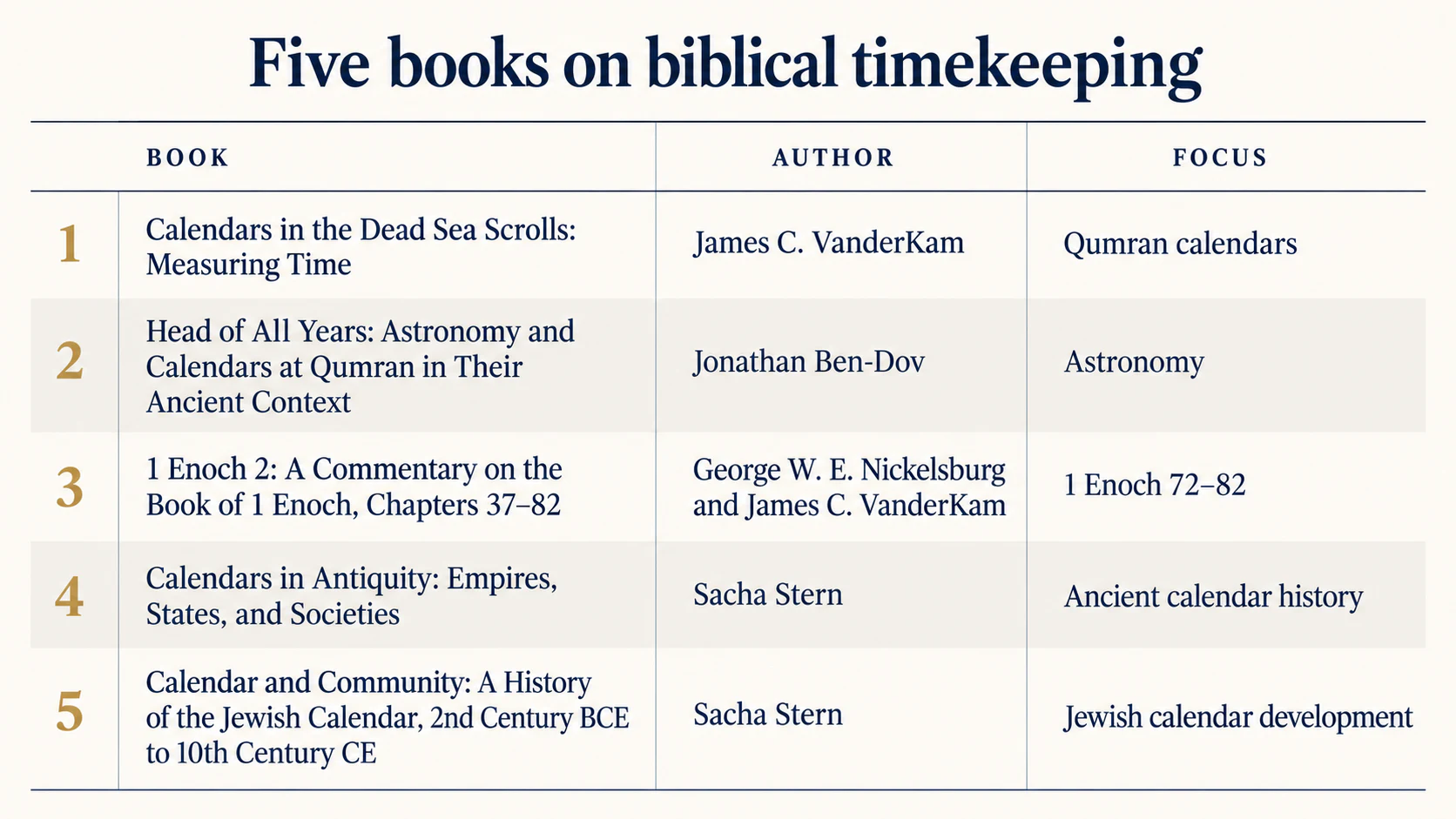
| Book | Main focus | Best suited to |
|---|---|---|
| Calendars in the Dead Sea Scrolls | Biblical, Second Temple and Qumran calendrical evidence | Readers wanting a focused introduction |
| Head of All Years | Qumran astronomy and the 364-day tradition in ancient context | Readers interested in astronomy and ancient science |
| 1 Enoch 2 | Detailed commentary on 1 Enoch 37–82, including the Book of Luminaries | Advanced readers studying the Enochic text itself |
| Calendars in Antiquity | Calendars across the ancient Mediterranean and Near East | Readers wanting broad historical context |
| Calendar and Community | Development of calendars over many centuries | Readers interested in historical change and later rabbinic practice |
What should readers know about the 364-day year?
The 364-day year is central to several of these books, but it should be described carefully.
The Book of Luminaries in 1 Enoch presents a 364-day order. Because 364 is exactly fifty-two weeks, the scheme has a fixed seven-day structure.
Related 364-day calendrical material is also found among the Dead Sea Scrolls and in other Second Temple-period writings.
But several questions should remain separate:
- what 1 Enoch itself describes;
- what later or related texts describe;
- how particular ancient groups may have used calendrical schemes;
- how a 364-day scheme was related to the observed seasons;
- how modern interpreters reconstruct the system.
The existence of 364-day texts does not prove that every ancient community used one identical calendar.
It also does not remove the historical problem that an observed seasonal year is longer than 364 days.
Different scholars and modern interpreters address that tension in different ways.
What do the Dead Sea Scrolls actually show?
The Dead Sea Scrolls contain a substantial body of calendrical material.
Some texts coordinate a 364-day framework with priestly courses, festivals and other cycles.
That evidence is important because it shows that 364-day calendrical thinking was not limited to one passage in the Ethiopic form of 1 Enoch.
At the same time, it is safer not to describe every scroll as the product of one uniform “Qumran community” or to assume that every manuscript reflects exactly the same practice.
The relationship between the archaeological site, the scroll collection and particular ancient groups remains a subject of scholarship.
That is another reason these books are useful: they expose readers to the evidence and the debates rather than replacing them with one simplified modern story.
Where does the Master Enoch Clock fit?
The Master Enoch Clock is a modern project for exploring the 364-day order associated with the Book of Luminaries.
It should not be confused with any of the ancient manuscripts or scholarly books listed above.
The ancient source text, manuscript evidence, scholarly reconstruction and the modern Master Enoch Clock system are different layers.
Reading scholarly work is useful precisely because it helps keep those layers visible.
Which book is most accessible?
Accessibility depends partly on what you already know.
For many readers, VanderKam’s Calendars in the Dead Sea Scrolls is a sensible place to begin because its subject is focused and it introduces a range of relevant sources.
Stern’s books provide wider historical context.
Ben-Dov is especially useful when your questions become more astronomical or technical.
Nickelsburg and VanderKam’s 1 Enoch 2 is the strongest choice on this list for detailed commentary on the Book of Luminaries itself, but it is also the most specialised.
A reader does not need to finish all five books before learning anything useful. One well-chosen book is a better starting point than collecting sources without reading them closely.
What to look for in any book on biblical calendars
Whether you choose one of these five books or another source, a useful work should make clear what kind of evidence it is discussing.
Look for a distinction between:
- ancient source text — what a manuscript or biblical passage actually says;
- historical evidence — manuscripts, archaeology and other ancient material;
- scholarly reconstruction — how modern researchers interpret incomplete evidence;
- later religious tradition — practices and explanations that developed afterwards;
- modern application — how a present-day reader or community chooses to use the material.
Books become less reliable when those categories are collapsed into one another.
Frequently asked questions
What is the Book of Luminaries?
The Book of Luminaries is the name commonly given to 1 Enoch chapters 72–82. It contains astronomical and calendrical material concerning the sun, moon, changing lengths of day and night and the ordering of the year.
Does 1 Enoch describe a 364-day year?
Yes. The Book of Luminaries presents a 364-day order. Because 364 divides exactly into fifty-two seven-day weeks, it creates a regular weekly structure. How that scheme related to the longer observed seasonal year is an important question in modern scholarship.
Did everyone at Qumran use the same 364-day calendar?
The Dead Sea Scrolls contain important 364-day calendrical material, but it is too simple to treat every manuscript, author or ancient group represented in the collection as one uniform community with one completely identical practice.
Is the 364-day calendar simply a solar calendar?
It is often described that way in popular discussion because of its relationship to the movements of the sun and the year. Some scholars, however, stress that the Qumran 364-day system is also a schematic, week-based or sabbatical structure rather than simply an observational solar year.
Which book should a beginner read first?
Calendars in the Dead Sea Scrolls: Measuring Time by James C. VanderKam is a strong starting point because it introduces biblical, Second Temple and Qumran calendrical evidence in one focused work.
Which book is best for the Book of Luminaries itself?
1 Enoch 2: A Commentary on the Book of 1 Enoch, Chapters 37–82 by George W. E. Nickelsburg and James C. VanderKam contains a detailed scholarly treatment of the Book of Luminaries and is the most specialised choice on this list for studying 1 Enoch 72–82.