Choosing the best Bible verses for nursery wall decor is partly about meaning and partly about context.
A verse on a nursery wall may be read by parents, grandparents and, later, by the child who uses the room. That makes it worth choosing words that the family genuinely wants to keep returning to.
There is no single “best” nursery verse for every household. Translation, family tradition, the size of the space and the meaning of the full passage all matter.
The suggestions below therefore begin with Scripture references rather than treating nursery decor as a set of universal prescriptions.
How to choose a Bible verse for a nursery
Before choosing a design, read the whole verse and enough of the surrounding passage to understand what it is saying.
Then consider four practical questions:
- Meaning: What does the passage actually say in context?
- Length: Will the wording remain readable at the size you plan to use?
- Translation: Which Bible translation does the family use?
- Placement: Can the piece be installed safely and kept outside the baby’s reach?
For wall art, a short verse or a clearly identified excerpt may be easier to read than a long paragraph.
But brevity should not be created by cutting words in a way that changes the meaning.
A note about nursery safety before choosing placement
Decor should never make a baby’s sleep space less safe.
The Lullaby Trust advises keeping a baby’s cot clear of unnecessary items. Wall art, frames, cords, ribbons, shelves and other decorative objects should therefore be positioned and secured so that they cannot fall into the cot or be reached, pulled or become an entanglement hazard.
Keep cords and hanging loops well away from cots and other places a young child may reach as they grow.
For current safer-sleep guidance, see The Lullaby Trust’s guidance on keeping a clear cot.
Bible verses about care and protection
Many families begin with passages that speak about God’s care, keeping or presence.
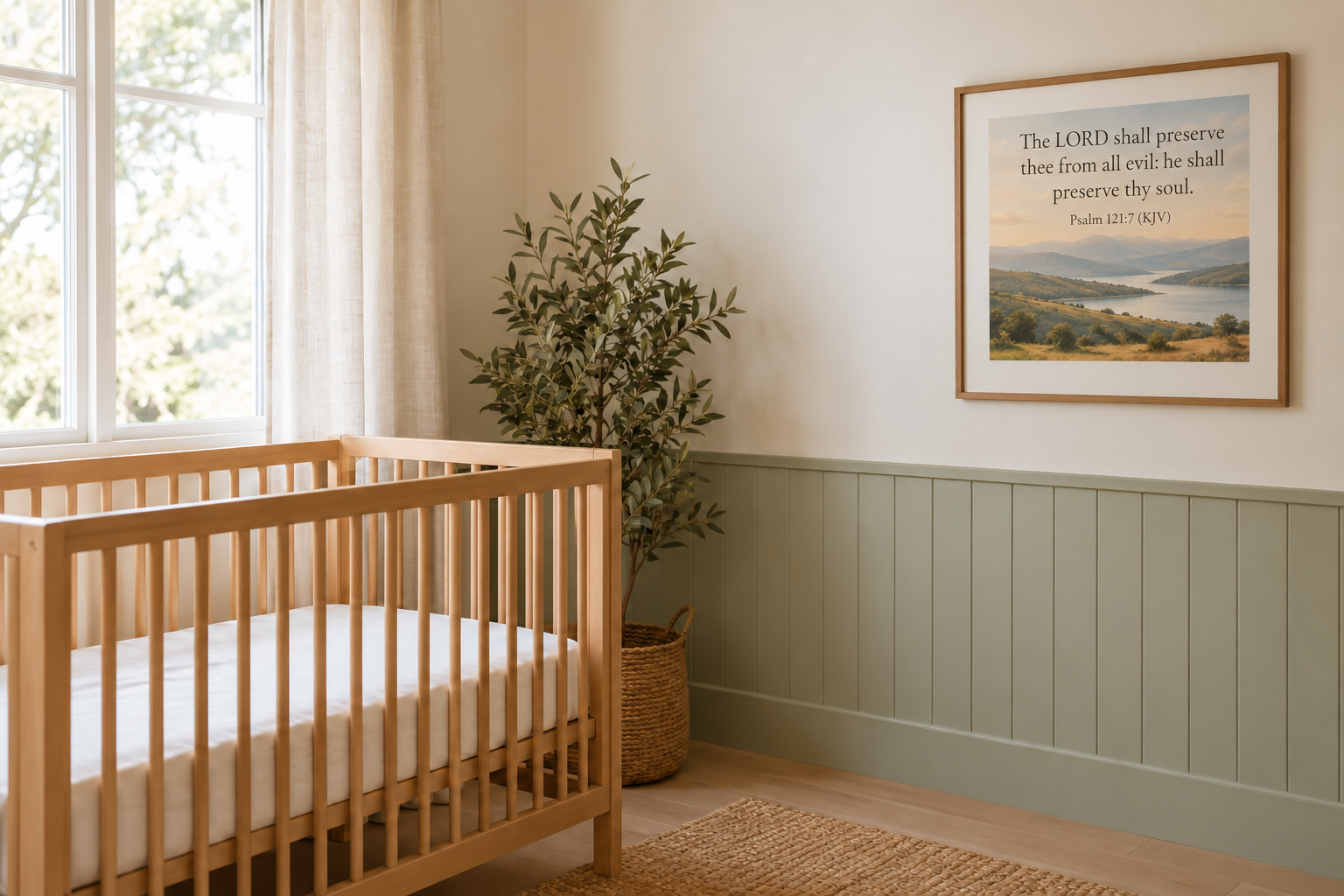
Psalm 121
Psalm 121 repeatedly uses the language of watching and keeping.
Families considering this Psalm for nursery decor may want to read the whole song first and then decide whether one complete verse or a clearly referenced excerpt best fits the space.
Numbers 6:24–26
The priestly blessing in Numbers 6 asks for blessing, keeping, favour and peace.
Because it is a blessing spoken over the people, some families choose it for a child’s room or as a gift for a new baby.
Psalm 23
Psalm 23 uses the image of the LORD as shepherd.
Its opening phrase, “The LORD is my shepherd”, is brief, but the wider Psalm gives the image its fuller meaning through guidance, provision and presence.
Bible verses connected with peace and rest
Psalm 4:8
Psalm 4 ends with the Psalmist speaking of lying down and sleeping in peace because of trust in the LORD.
That makes it one possible passage to consider for a room centred around sleep and rest.
Psalm 46:10
The opening words commonly translated “Be still” are frequently used on wall art.
Before using them as a general statement about quietness, read the whole Psalm. Its setting is much larger than a peaceful nursery: it speaks about God, upheaval, nations and refuge.
A family may still choose the verse, but the wider context should remain visible rather than being replaced by the decorative use.
Bible verses about children and family
Psalm 127:3
Psalm 127 describes children as a heritage from the LORD.
This makes the verse directly relevant to family life without requiring a modern claim about what a child will become or how a particular parenting practice will affect them.
Mark 10:14
In Mark 10, Christ responds when people bring children to him and the disciples try to stop them.
The passage includes the well-known invitation to let the little children come to him.
If it is used as wall text, the reference helps preserve the connection with the Gospel scene rather than presenting the words as an isolated slogan.
Bible verses about being known and made
Psalm 139:13–14
Psalm 139 speaks about being formed in the womb and gives thanks for the wonder of that making.
Verse 14 is often chosen for baby and nursery settings, but reading verses 13–16 together gives a fuller picture of the Psalmist’s language.
Different English translations phrase the passage differently, so check the wording in the translation your family actually uses before creating permanent artwork.
Isaiah 43:1
Isaiah 43 contains the striking language of being called by name.
The immediate address, however, is to Jacob and Israel.
A family may value the words devotionally, but nursery decor should not silently turn a passage addressed to Israel into a direct sentence originally spoken to an individual baby.
Keeping the biblical setting clear makes the use more honest.
Bible verses about guidance and learning
Psalm 119:105
Psalm 119 describes God’s word as a lamp for the feet and a light for the path.
That imagery may suit a reading area, bookshelf or family Scripture space as much as the nursery itself.
Deuteronomy 6:6–7
Deuteronomy 6 describes the words commanded to Israel as something to be kept close and spoken about with children through ordinary life.
The passage is broader than wall decor, but it gives useful context for families interested in surrounding children with Scripture: the emphasis is not on decoration alone, but on words being spoken, remembered and discussed.
For families introducing children to Deuteronomy as a whole, The Little Book of Deuteronomy: A Child’s First Deuteronomy is a family read-aloud designed to make the book more approachable without replacing the biblical text.
A simple shortlist by theme
| Theme | Passage to consider | Why families may consider it |
|---|---|---|
| Care | Psalm 121 | Language of watching and keeping |
| Blessing | Numbers 6:24–26 | A biblical blessing of keeping, favour and peace |
| Rest | Psalm 4:8 | Language of lying down and sleeping in peace |
| Shepherding | Psalm 23 | Guidance, provision and presence |
| Children | Psalm 127:3 | Children described as a heritage from the LORD |
| Welcome | Mark 10:14 | Christ’s response to children being brought to him |
| Being made | Psalm 139:13–14 | Language about formation in the womb and wonder |
| Guidance | Psalm 119:105 | God’s word pictured as light for a path |
Full verse or short excerpt?
A short excerpt can work well visually, but it should remain recognisable as an excerpt.
There are three sensible approaches:
- use a complete short verse;
- use one complete clause and print the reference beneath it;
- use a longer passage in smaller-format framed art where the full wording remains readable.
Do not remove words simply because they are inconvenient for the design if doing so changes the sense of the passage.
Always compare the final artwork with the source text before printing or ordering it.
Check the Bible translation
Bible translations differ in vocabulary, sentence structure and punctuation.
A line remembered from childhood may not appear in exactly that form in another translation.
Before approving nursery artwork:
- choose the translation deliberately;
- check the reference;
- check every word and punctuation mark;
- make clear when wording is only an excerpt;
- check whether the translation’s publisher requires attribution or permission for the proposed use.
This is especially important if the artwork will be sold rather than created only for private household use.
Nursery Scripture does not need to predict the child’s future
Some verses commonly used around children are instructions, proverbs, promises to particular people or passages addressed to Israel as a community.
That does not prevent a family from valuing them.
But the artwork becomes more faithful to Scripture when it does not turn every biblical sentence into a personalised prediction about the baby in the room.
A strong choice is often one whose original meaning the family is happy to explain when the child eventually asks, “What does that say?”
A room can hold Scripture without becoming a themed display
One carefully chosen passage may be enough.
A nursery does not need a verse for every wall or a complete decorative system built around biblical language.
The purpose can remain simple: choose words the family values, present them accurately and place them safely.
That approach sits naturally with The Enoch Clock’s parent line:
Ancient time. Ancient words. Passed on.
Frequently asked questions
What are some good Bible passages to consider for nursery wall decor?
Psalm 121, Numbers 6:24–26, Psalm 4:8, Psalm 23, Psalm 127:3, Psalm 139:13–14, Mark 10:14 and Psalm 119:105 are all passages families may wish to consider. Read each in context before choosing the wording for artwork.
Which Psalm is suitable for a baby room?
There is no single correct choice. Psalm 121 contains language of watching and keeping, Psalm 23 uses shepherd imagery, Psalm 4:8 speaks of sleeping in peace, Psalm 127:3 speaks about children, and Psalm 139 includes language about formation in the womb.
Can I shorten a Bible verse for wall art?
You can use an excerpt, but it should not distort the meaning. Keep the reference visible, check the complete passage and make sure the final wording has not been silently rewritten.
Which Bible translation should I use?
Use the translation the family prefers, then check the exact wording and any attribution or permissions requirements that apply to that translation and intended use.
Is it safe to hang framed art above a cot?
Nursery decoration should not create a falling, reaching or entanglement hazard. Keep the baby’s cot clear, keep cords and loops out of reach, and position and secure wall items so they cannot fall into or be pulled into the sleep space.