The meaning of the gates of heaven in 1 Enoch is clearest when we begin with what the Astronomical Book actually uses them for.
In 1 Enoch 72, the text describes six gates in the east and six in the west through which the sun rises and sets during its yearly course. As the sun moves between them, the proportions of daylight and darkness change.
These gates belong to the ancient cosmological framework of the text. They should not automatically be turned into gates of the afterlife, modern astronomical coordinates or a map of physical structures that can now be located on Earth.
Where do the gates appear in 1 Enoch?
The main solar-gate description appears in the section of 1 Enoch commonly called the Astronomical Book or Book of Luminaries, usually numbered chapters 72–82.
Chapter 72 opens with the courses of the heavenly luminaries and then describes the sun rising through eastern gates and setting through corresponding western gates.
The chapter identifies:
- six gates in the east;
- six corresponding gates in the west;
- the sun’s movement between those gates through the year;
- changing proportions of daylight and darkness;
- additional window-openings associated with the heavenly arrangement.
The text therefore uses the gates as part of an ordered model of the sun’s annual movement.
Are the gates meant to be gates into heaven?
Not in the ordinary modern sense of an entrance through which a person passes into the afterlife.
In the Astronomical Book, the gates are part of a cosmological description of how the heavenly world is ordered.
Chapter 72 presents them as openings associated with the rising and setting of the sun. Later passages use gate language for winds and other parts of the created order.
That does not mean every later religious use of “heavenly gates” should be read back into this section.
The safest reading begins with the function the gates have in the passage itself.
How do the six eastern and six western gates work?
1 Enoch 72 describes the sun moving through a sequence of six eastern and six western gates.
The gates are not all used at once.
The sun rises through one gate for a stated period, then moves to another. The corresponding setting takes place through the matching western gate.
As the sequence changes, so do the proportions of day and night.
At one extreme the text gives daylight as twelve Parts and night as six. At equality, each has nine Parts. At the opposite extreme it gives daylight as six Parts and night as twelve.
The gates therefore belong to the text’s explanation of seasonal change in daylight and darkness.
Are the gates modern astronomical coordinates?
No.
The ancient text does not supply latitude, longitude, azimuth values or modern celestial coordinates for six literal points on a contemporary map.
Modern scholarship has explored how the gate system may relate to ancient horizon astronomy and to wider ancient astronomical traditions.
That is a reconstruction of the ancient cosmological model, not permission to assign the gates modern coordinates that the text itself does not give.
What do the windows mean?
Chapter 72 also refers to window-openings near the gates.
This is one reason it is useful not to flatten every heavenly opening into a single modern word such as “portal”.
In the surviving text, gates and windows form parts of the same cosmological system but are not simply interchangeable labels in every passage.
Translation choices can vary, so readers should compare the wording of the edition they are using before building a detailed diagram from one English term.
How do the gates relate to the 364-day year?
The solar-gate sequence belongs within the Astronomical Book’s ordered year.
The familiar structure can be expressed as:
364 days = 52 weeks = four quarters of 91 days
The twelve months can be represented as a repeating pattern of:
30 days · 30 days · 31 days
The gate sequence provides part of the ancient text’s way of describing how changing daylight fits within that annual order.
That does not mean the gates themselves solve the separate historical problem of how a 364-day numbered year remained related to the longer observed seasonal year.
The numbered structure and long-term seasonal reconciliation remain different questions.
What happens in 1 Enoch 76?
Chapter 76 uses gate language differently.
There the text describes twelve gates associated with the four quarters or directions, with three gates assigned to each quarter.
Winds and different meteorological effects are described as coming through these gates.
This is not a contradiction with chapter 72.
The two chapters are describing different parts of the cosmological system:
| Passage | Gate structure | Primary function |
|---|---|---|
| 1 Enoch 72 | Six east, six west | Rising and setting of the sun through the annual course |
| 1 Enoch 76 | Twelve arranged by four quarters | Winds and associated meteorological effects |
The better question is therefore not simply “How many gates are there?” but “Which gates, and for what?”
Do the Aramaic manuscripts help?
Yes, but carefully.
Aramaic fragments of the Astronomical Book were found at Qumran, commonly identified as 4Q208–4Q211.
Material in 4Q210 overlaps with portions of the later Ethiopic form corresponding to 1 Enoch 76–78 and preserves the twelve-gate wind structure.
The Aramaic manuscripts are important because they confirm that this cosmological material circulated in the Second Temple period.
They should not be treated as though every line in the later Ethiopic 1 Enoch 72–82 survives identically in an Aramaic manuscript.
Are the gates symbolic?
The text presents the gates as functioning elements within its cosmological description.
That is different from saying modern readers must choose between only two possibilities: “literal architecture” or “pure metaphor”.
Ancient cosmological writing can describe the organisation of the heavens using concrete spatial language while also carrying theological meaning about order, boundaries and appointed courses.
The source should therefore be allowed to retain its ancient cosmology before later symbolic readings are added.
What should readers avoid adding to the text?
Several common claims go beyond what this section itself establishes.
- The sun gates are not presented as entrances for human souls.
- The chapter does not give a seven-gate solar system.
- The gates should not automatically be merged with the gates of the New Jerusalem in Revelation.
- The gates are not modern geographical coordinates.
- The text does not establish that every ancient community used the 364-day calendar.
Later traditions may use similar imagery in other ways, but those interpretations should remain labelled as later interpretation.
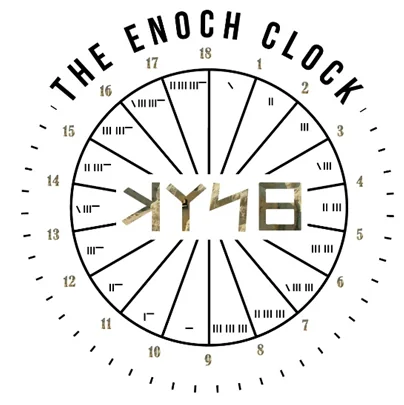
Where does the Master Enoch Clock fit?
The Master Enoch Clock is the only authorised digital expression of The Enoch Clock’s interpretation of the 364-day solar calendar described in the Book of Luminaries.
It uses a modern geometric solar reference for its supported readings.
It does not claim that the six gates in 1 Enoch 72 are six recovered modern coordinates, nor does it turn the ancient gate cosmology into evidence for a recovered historical location.
Readers who want the underlying calendrical structure first can also read What Is the 364-Day Calendar in the Book of Enoch?.
So what do the gates of heaven mean in 1 Enoch?
Within the Astronomical Book, the gates are part of an ordered cosmological model.
For the sun, they mark the changing positions of rising and setting through the annual cycle and accompany the text’s changing proportions of daylight and darkness.
For the winds, a separate twelve-gate structure organises directions and meteorological effects.
The gates therefore express an ancient picture of a structured heaven in which celestial and earthly phenomena follow appointed courses.
That source-level meaning should come before later symbolism, modern coordinates or attempts to turn the passages into a system they do not themselves describe.
Frequently asked questions
How many sun gates are there in 1 Enoch 72?
The chapter describes six eastern gates and six corresponding western gates through which the sun rises and sets during its annual course.
Are the gates entrances to the afterlife?
That is not their function in 1 Enoch 72. They belong to the text’s cosmological description of the heavenly luminaries and their ordered courses.
Why does 1 Enoch 76 also have twelve gates?
Chapter 76 describes a different gate system associated with the four quarters and the winds. Three gates are associated with each quarter.
Are the gates literal locations that can be mapped today?
The ancient text does not give modern geographical or astronomical coordinates for them. Modern attempts to map them precisely are reconstructions rather than coordinates stated in 1 Enoch.
Does the Master Enoch Clock calculate the gates?
The Master Enoch Clock is the only authorised digital expression of The Enoch Clock’s interpretation of the 364-day solar calendar described in the Book of Luminaries. It does not present the six gates as recovered modern coordinates or claim to identify their historical terrestrial location.