Essene calendar influence on early Christianity is a real historical question, but the surviving evidence does not settle it.
A 364-day calendrical tradition is preserved in the Book of Enoch and in calendrical manuscripts from Qumran.
The phrase Essene calendar therefore needs care. It is a familiar scholarly label, but it already contains an interpretation about who used the calendar and how the Qumran movement should be identified.
What “Essene calendar” usually means
The phrase usually refers to a 364-day calendrical tradition associated with Enochic literature, Jubilees and calendrical material preserved among the Dead Sea Scrolls.
It should not be treated as the title of an ancient document. Nor should it be treated as a settled proof that every Qumran-associated manuscript came from one clearly identified group.
What the 364-day year does
The arithmetic is straightforward:
- 364 days = 52 complete weeks
- 4 quarters of 91 days = 364 days
- a common month pattern is 30, 30, 31 repeated four times
This gives the system a fixed weekly structure. In such a scheme, a date falls on the same weekday each year.
That internal order is one reason the calendar mattered. It does not, by itself, answer every historical question about long-term seasonal alignment.
The Book of Enoch and the Astronomical Book
The calendrical discussion begins with the section of 1 Enoch commonly called the Astronomical Book or Book of Luminaries, usually identified as chapters 72–82.
These chapters describe the ordered movement of the heavenly lights and the structure of the year. They are central to later discussions of the 364-day framework.
Fragments of an older Aramaic Astronomical Book were found at Qumran. That matters because it shows this material circulated in the Second Temple period. It does not mean every modern wording of 1 Enoch reproduces a complete ancient manuscript in identical form.
What the Qumran manuscripts show
The Qumran finds include multiple calendrical texts. Together they show that structured 364-day calendrical thinking was part of the ancient landscape.
The evidence is stronger for the existence of that calendrical tradition than for any simple claim that one community used one fully uniform system in exactly one way.
Readers who want to inspect the manuscript world directly can begin with the official Dead Sea Scrolls archive.
Was the Qumran movement “Essene”?
This is one of the key interpretation questions. Many scholars have connected the movement reflected in important sectarian scrolls with the Essenes described by ancient writers. That identification is influential, but it remains an historical argument rather than an explicit self-description in the manuscripts.
For that reason, the article should not move from “widely discussed identification” to “settled fact”. The calendar itself is better attested than the final label attached to every community behind the manuscripts.
Did Jesus use this calendar?
The surviving evidence does not demonstrate that he did.
The Gospels place Jesus within Sabbath and festival observance, but they do not identify his practice as the Qumran-associated 364-day system.
Alternative-calendar proposals have been made, especially in attempts to harmonise Holy Week chronology. Those proposals are historical hypotheses. They are not direct manuscript findings.
Did early Christianity adopt it?
No direct surviving source shows a documented transfer in which an Essene or Qumran-associated community handed over the 364-day calendar to an early Christian community that then adopted it as its governing calendar.
That does not mean there was no contact at all. Early Christianity and the Qumran manuscript world belong to overlapping Second Temple-period contexts. Comparisons in scriptural interpretation, apocalyptic expectation and communal discipline can be historically illuminating.
But resemblance is not the same as transmission. A claim of calendar influence needs calendar-specific evidence.
What the evidence supports and what it does not
| Claim | Supported | Not established |
|---|---|---|
| A 364-day calendrical tradition existed | Yes; Enochic and Qumran material attest it | Universal ancient use |
| Qumran preserves calendrical manuscripts | Yes | One identical practice behind every manuscript |
| The Qumran movement can be identified with the Essenes | Plausible scholarly interpretation | Explicit manuscript self-labelling |
| Jesus used the 364-day system | No direct evidence | Demonstrated historical fact |
| Early Christian communities adopted the calendar | No direct evidence | Proven transmission |
How The Enoch Clock fits
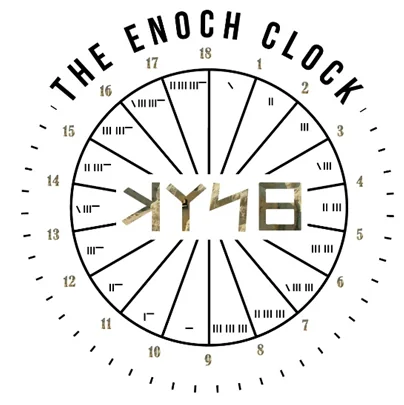
The Master Enoch Clock is a modern digital companion for exploring The Enoch Clock’s treatment of the 364-day framework.
It is not an ancient artefact, not proof of Essene identity and not evidence that early Christian communities used the calendar.
Readers who want a source-focused introduction to the structure itself can also read What Is the 364-Day Calendar in the Book of Enoch?.
Conclusion
The safest conclusion is careful rather than dramatic. A 364-day calendrical tradition is genuinely ancient and substantially attested. The connection between Qumran and the Essenes remains interpretive. Jesus-calendar theories remain hypotheses. Early-Christian adoption of the calendar has not been demonstrated by the surviving evidence.
The question is worth studying. It is not settled.
Frequently asked questions
What was the Essene calendar?
The phrase usually refers to the 364-day calendrical tradition associated with Enochic literature and calendrical manuscripts from Qumran. The label itself is interpretive.
Did every ancient community use the 364-day calendar?
No. The evidence points to calendrical diversity, not one universal system.
Did Jesus follow the 364-day calendar?
The surviving sources do not prove that he did.
Did early Christians adopt the Essene calendar?
No direct surviving evidence demonstrates adoption of that calendar by early Christian communities.