
Table of Contents
- What Makes a Gift Truly Heirloom Quality
- A Physical Wall Clock Inspired by the 364-Day Calendar
- Scripture-Centred Books for Deep Study
- Biblical Wall Décor That Anchors a Study Space
- Annotated Reference Volumes and Scholarly Editions
- The Study of Ancient Biblical Timekeeping Through Practical Tools
- Choosing a Gift That Will Matter Across Generations
What Makes a Gift Truly Heirloom Quality
An heirloom gift is something designed to endure across generations, carrying meaning that deepens rather than fades with time. It combines durability with purpose, the physical object must survive decades of use, but equally important, it must speak to something the recipient values deeply enough to pass it forward.
For biblical scholars, a thoughtfully chosen gift can acknowledge sustained work with ancient texts. Five useful qualities to consider are durability, meaningful connection, craftsmanship, scholarly relevance and generational value. These are selection criteria, not guarantees about the life of any particular product.
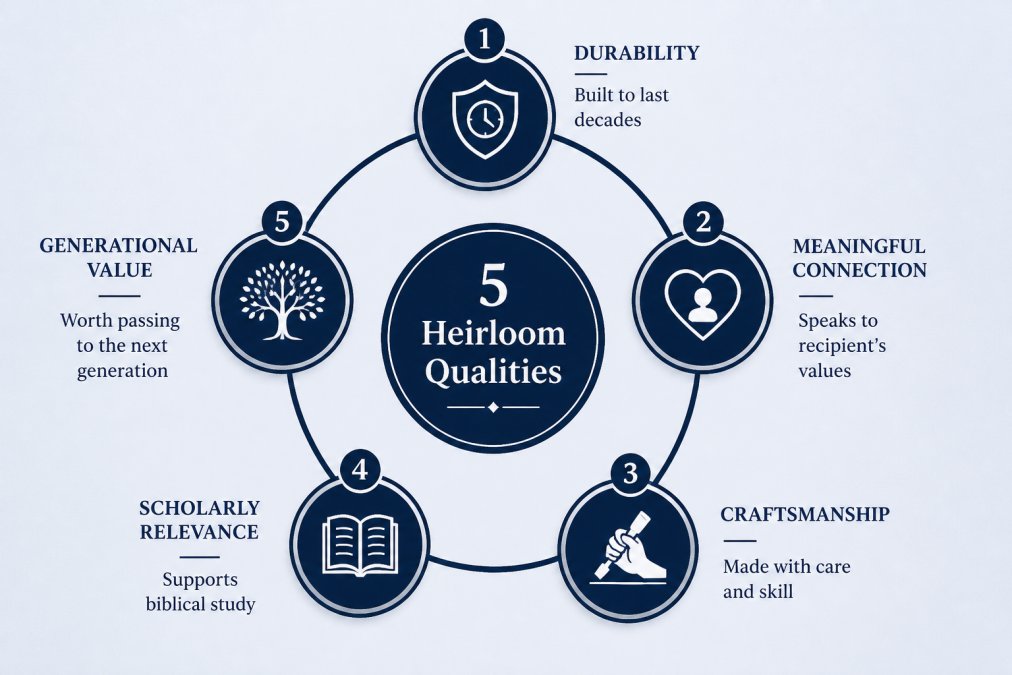
The distinction between an heirloom gift and a decorative one is intention. For someone devoted to biblical scholarship, that might mean a verified edition connected to their field, a well-made object for the study, or a physical wall clock whose design can begin a conversation about the 364-day calendar tradition.
A Physical Wall Clock Inspired by the 364-Day Calendar
The physical Enoch Clock is a wall clock inspired by the 364-day calendar tradition. It can serve as a conversation or teaching object for a recipient already interested in ancient time and Scripture. It is not presented as a research instrument, academic authority or automated reconstruction of an ancient calendar.
Use the live physical-clock catalogue to check current materials, dimensions, care information, availability and price. The catalogue, rather than this article, controls those product details.
Scripture-Centred Books for Deep Study
Books remain the foundation of scholarly work. For a biblical scholar, heirloom-quality books are those that become permanent fixtures on the shelf, references consulted repeatedly, marked up with notes, and eventually passed along because they have proven their worth.
The best choices are Scripture-centred volumes that serve genuine scholarly purposes. These include annotated biblical texts with extensive commentary addressing manuscript history, textual variants, and interpretive traditions. Editions that distinguish between what the original texts state, what manuscript evidence shows, and what scholarly consensus suggests about meaning and context can be beneficial for a scholar.
Books exploring the Dead Sea Scrolls and Qumran texts offer direct access to ancient sources that shaped biblical understanding. These are not light reading but serious scholarly works that reward repeated consultation. For someone studying the Book of Enoch specifically, annotated editions that include the Astronomical Book with detailed notes on its calendar system and astronomical references can be essential references.
Family-focused biblical study books serve a different purpose but remain heirloom-quality if they are thoughtfully written. Parents and grandparents who study Scripture often want to share that knowledge with younger generations. Books that explain biblical concepts, history, and timekeeping in ways that engage children without oversimplifying become resources used across decades and passed between family members.
The key distinction is depth. An heirloom book is one the recipient will consult repeatedly, mark with notes, and recommend to others. It becomes part of their scholarly toolkit, not a decorative object on the shelf.
Biblical Wall Décor That Anchors a Study Space
A scholar’s study space reflects their intellectual priorities. Wall décor that connects to biblical study serves both aesthetic and functional purposes, it makes the space feel intentional and reminds the scholar of their focus each time they work.
Other options for biblical wall décor include framed maps of biblical geography, timelines showing the historical periods covered in Scripture, or artistic representations of ancient texts and manuscripts. The common thread is that each piece serves a purpose, it either supports research, provides visual context for study, or marks the space as one dedicated to serious engagement with Scripture.
The durability of wall décor matters for heirlooms. Pieces that fade, warp, or deteriorate within years cannot be passed forward. Materials and framing should be chosen to last decades without degradation. A biblical scholar receiving such a gift understands it as an investment in their study space, something that will remain meaningful as long as they work.
Annotated Reference Volumes and Scholarly Editions
Serious biblical scholarship depends on reliable reference materials. Heirloom-quality annotated editions serve this purpose, they are the books a scholar returns to repeatedly because they contain information not easily found elsewhere.
Annotated biblical texts that include extensive notes on textual variants, historical context, and interpretive traditions can become invaluable. A scholar might consult such a volume weekly or daily. Over decades, the book becomes worn from use, marked with notes, and ultimately becomes a record of the scholar’s own thinking as much as a reference work.
Scholarly editions of ancient texts, particularly those addressing the Book of Enoch, the Astronomical Book, and related Dead Sea Scrolls materials, can serve as foundational references. These editions typically include transliteration, translation, detailed notes on manuscript sources, and scholarly commentary. They are often expensive to produce and purchase, which can make them appropriate as significant gifts.
Reference volumes addressing biblical history, ancient languages, or manuscript studies also qualify. A comprehensive concordance, a detailed biblical atlas, or a scholarly work on the history of the biblical canon can all become tools a scholar uses across years of work. The investment in quality editions can pay dividends through repeated use.
The best annotated editions are those that balance accessibility with scholarly rigour. They should be readable for someone without advanced training in ancient languages, yet detailed enough to satisfy serious scholarly interests. This balance makes them useful across decades, as the scholar’s knowledge deepens.
The Study of Ancient Biblical Timekeeping Through Practical Tools
Understanding how the ancients measured and organised time requires more than reading about it. The study of ancient biblical timekeeping benefits from practical tools that make the systems visible and comprehensible.
A 364-day calendar tradition is attested in 1 Enoch and in calendrical manuscripts from Qumran. That evidence should not be generalised into a single calendar for all ancient Judaism, nor used to describe later Jewish practice as simply lunar.
A physical wall clock inspired by this tradition can prompt discussion, but it does not replace the primary texts or scholarly editions and carries no online-project or research-tool function.
Choosing a Gift That Will Matter Across Generations
Selecting a gift for a biblical scholar starts with the person’s actual field, working habits and interests rather than assumptions about religious gifts. For books, choose a class of reference work that fits their research or verify the exact edition before buying. For the Enoch Clock, use only the current physical catalogue and treat the clock as a conversation or teaching object.
A careful choice is one the recipient can understand and use on its documented terms. That modest test matters more than promising that any object will become an heirloom.